

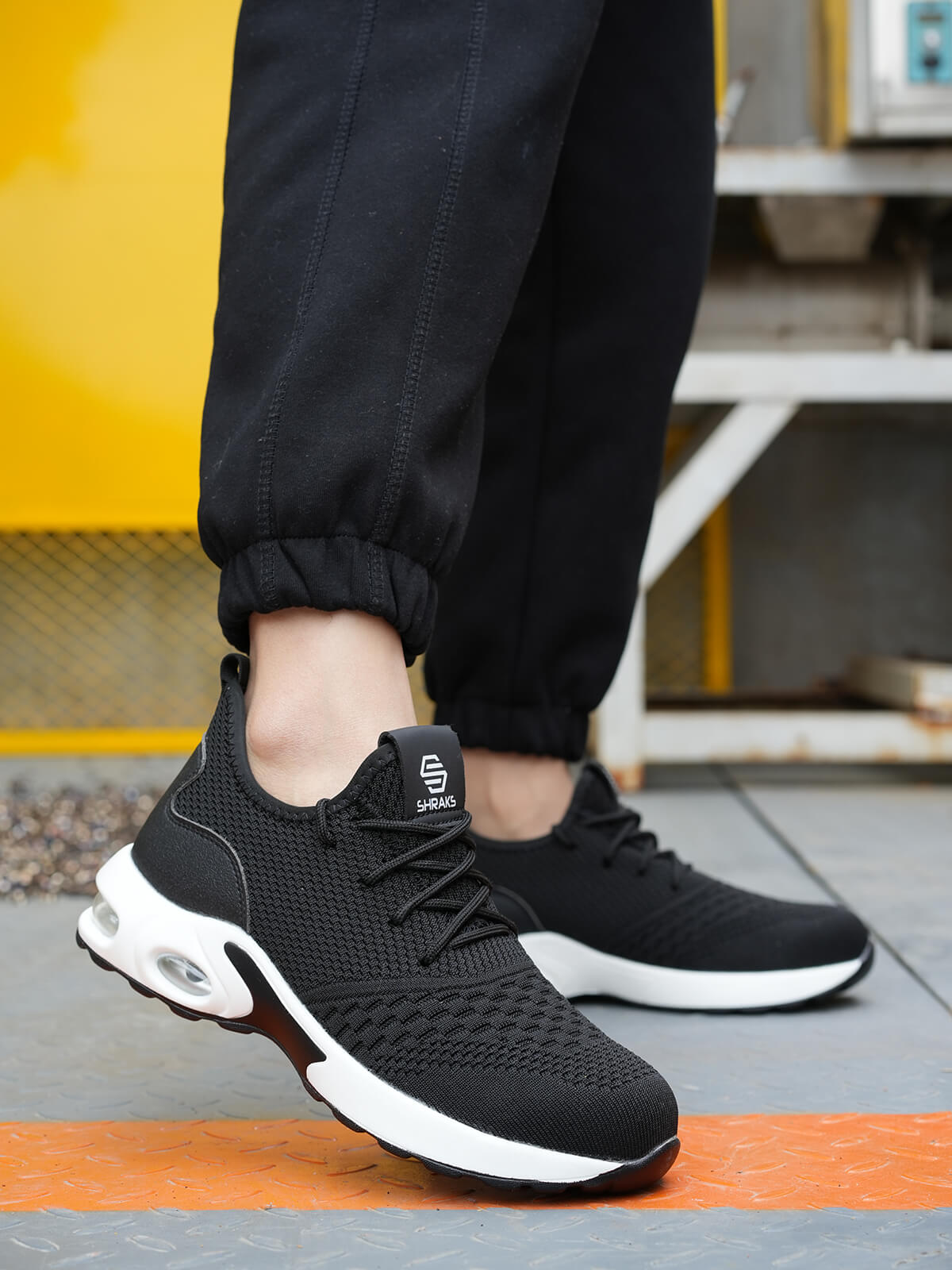
Looking for lightweight safety shoes that truly fit? The right fit determines comfort, stability, and safety during long shifts. In this guide you’ll learn what to consider about width, sizes and plus sizes, which standards matter, and how to choose correctly for women and men. Practical tips ensure your shoes feel great from day one. For a focused selection of lightweight styles for women, see our lightweight safety shoes for women.
Why fit matters in lightweight safety shoes
Lightweight safety shoes ease the load on your back, knees, and feet—but only with the right fit do they deliver full comfort. Shoes that are too narrow pinch the forefoot, reduce cushioning, and raise the risk of blisters or numbness. Shoes that are too wide let the heel slip, reduce stability, and compromise slip resistance. Aim for enough toe room, secure heel lock, and a natural roll. Women often benefit from a last with a narrower heel and sufficient forefoot room, while men tend to need more midfoot volume. Unisex models work well if the last is neutral and sizing is precise. Find more practical fit tips in the work sneaker guide to the right size and fit.
Understanding width, widths, and plus sizes
Width isn’t the same as size. Many brands offer different widths, sometimes indicated as width 11–14 or codes like W, XW, and XXW. These refer to forefoot circumference and help prevent pressure points. Measure both feet in the afternoon under load and note length and width. A guide to measuring correctly: sizing tips helps with choosing length and width. If you wear thick work socks regularly or use orthotic insoles, account for the extra space needed. In plus sizes, beyond length, outsole stability and midfoot lock are key so the shoe doesn’t feel mushy. Shraks currently offers sizes 35 to 47. If you need sizes above that or extra widths, check the manufacturer’s width marking and consider sizing up in EU size if your forefoot is broad.
How to find your right size and fit
Try on your safety shoes late in the afternoon with your typical work socks. You should have about a thumb’s width of space up front; the heel must sit securely and not slip when walking. Test walking, direction changes, squatting, and stairs. Look for even forefoot pressure distribution and midfoot support. Removable insoles can be swapped for more supportive versions as long as EN ISO 20345 compliance is maintained. If you’re between sizes, pick the larger for wide feet and the smaller for narrow feet. With Shraks, you order risk-free with a 60-day return window, so you can try at home. A lightweight safety sneaker comparison also helps you judge weight and comfort.
Shraks models and fit notes
Shraks blends sneaker comfort with EN ISO 20345 safety. Models like Shraks Moda, Venu, Moon, Stride, and Nova are lightweight; all of them offer S1P protection with a toecap, slip-resistant outsole, and penetration-resistant midsole, often Kevlar. The fit is sporty and suitable for construction, logistics, hospitality, and healthcare. Sizes 35–47 cover many women and men. If your foot is at the upper end of a size or your forefoot is broader, choose the larger EU size and check heel lock carefully. Find a full overview of current models in our safety sneakers for women & men.
FAQ
Should you buy work shoes one size up?
No—don’t size up by default. Aim for about a thumb’s width of toe room and a secure heel lock. If you wear thick socks or your feet swell notably, a half to full size up can make sense. For wide feet, a wider width is usually better than simply going longer.
What are the lightest safety shoes?
Particularly light are low-cut S1P models with textile uppers, aluminum or composite toecaps, and Kevlar puncture protection. Such shoes often weigh around 400–600 g per shoe in EU 42. The less metal, the more breathable the materials, and the sportier the build, the lower the weight. See our comparison of the lightest safety shoes for current picks.
What’s the difference between S1P and S1PS?
S1P commonly denotes safety shoes with toe protection, antistatic properties, heel energy absorption, fuel resistance, and puncture protection. With the EN ISO 20345 update, S1S/S1PS was introduced, adding stricter slip-resistance (SR) requirements. Many shops use both terms in parallel.
What do S1, S2 and S3 mean?
S1 includes a protective toecap, antistatic properties, heel energy absorption, and fuel resistance. S2 adds limited water uptake and water penetration resistance of the upper. S3 builds on S2 and adds puncture resistance and a profiled outsole. For dry indoor areas S1 often suffices; for wet, rough outdoor use S3 is usually best.


Leave a comment
This site is protected by hCaptcha and the hCaptcha Privacy Policy and Terms of Service apply.