

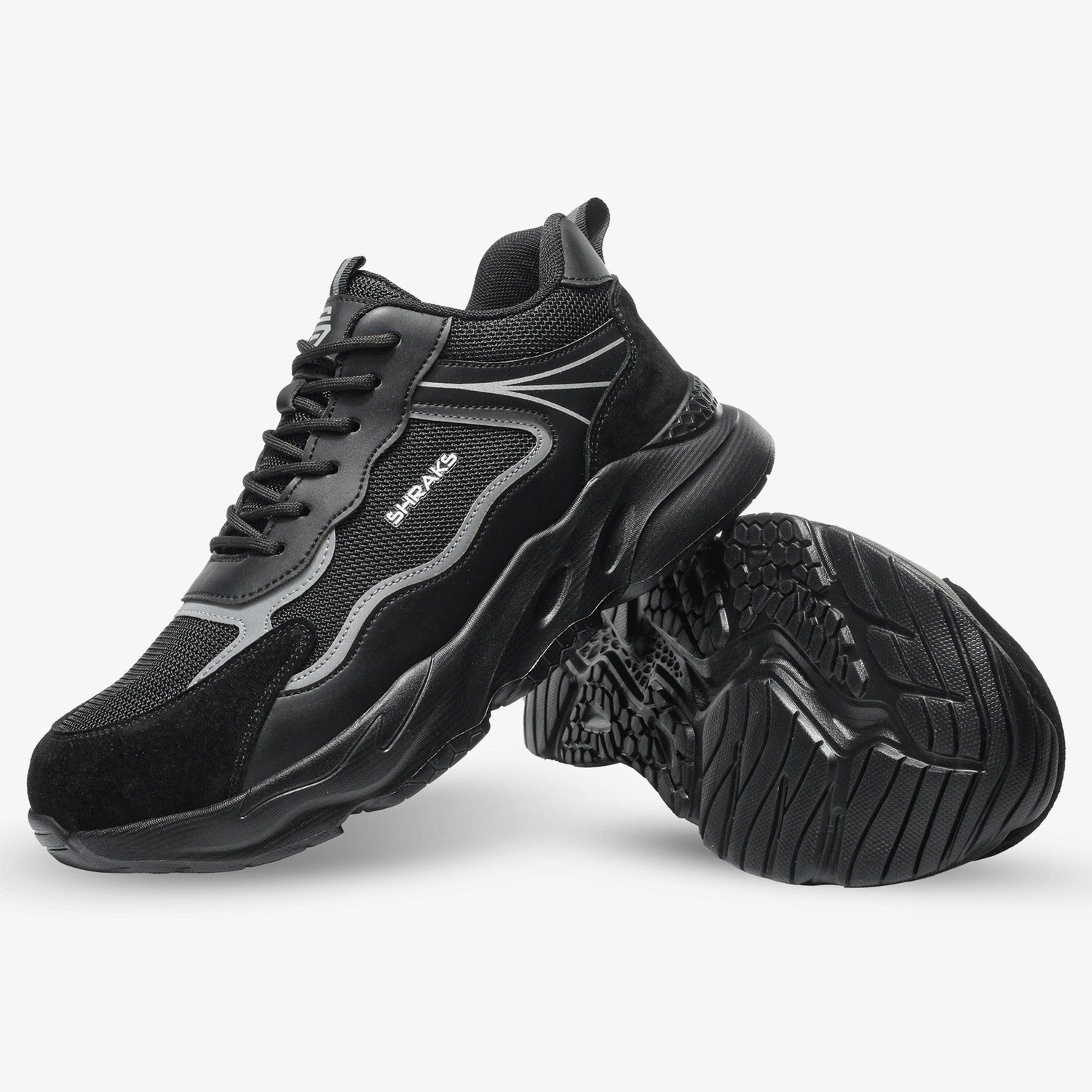
What is the difference between S1, S1P, S2 and S3 safety shoes, and which class fits your job? Here’s a clear EN ISO 20345 breakdown, practical examples and a comparison table so you can pick the right option fast without carrying too little or too much protection.
When do you need which safety class?
The right class depends on environment, floor hazards and moisture. Use this guide:
- Dry, indoor, no sharp edges on the floor - S1
- Dry, but risk from nails/chips/glass shards - S1P
- Damp or frequent splashes, no puncture risk - S2
- Outdoor/site-like, damp and puncture risk - S3
More detailed help per work environment is available in Which safety class for which workplace?.
Additional requirements like slip-resistant soles, heat resistance (HRO), cold/heat insulation (CI/HI) or ESD may be useful depending on the task.
EN ISO 20345 in brief
All EN ISO 20345 safety shoes feature a toecap (up to 200 J impact and 15,000 N compression). Classes differ by further mandatory properties. Broadly: S1/S1P/S2/S3 are usually leather/textile (Category I); S4/S5 are polymer/rubber (Category II). With the 2022 update, some codes were refined, e.g. puncture protection changed from P to PL (laminates/textile) or PS (steel). Slip resistance may be shown as SRC or SR depending on the standard. A detailed explanation is provided in EN ISO 20345: S1, S1P, S2, S3 explained.
S1 safety shoes: Dry areas with basic protection
S1 is the basic class for dry workplaces. It combines the toecap with antistatic properties (A), heel energy absorption (E) and fuel oil resistance (FO). Breathable uppers and sporty fits are common, improving comfort and feel. A compact overview of lightweight models by protection class is available in Lightweight safety shoe classes (S1–S3).
Typical uses: warehousing/logistics, assembly halls, electronics manufacturing without ESD requirement, workshops without wet zones. Important: S1 has no puncture resistance and no water repellency. If sharp objects may be on the floor or moisture is present, S1 is not enough.
S1P safety shoes: Dry, but with puncture resistance
S1P adds a puncture-resistant midlayer to S1. Depending on the standard, this appears as P (older) or more precisely as PL (textile/laminate) or PS (steel). Textile plates are often lighter and more flexible; steel excels at robust, point-load resistance. Both reliably protect against nails, chips and glass shards.
Typical uses: dry areas with elevated floor hazards, e.g. metalworking, carpentry, maintenance, event technology in halls. If moisture is involved or you often work outdoors, move to S3.
More details are available in S1P standard: features and benefits.
S2 safety shoes: Splash-resistant, without puncture resistance
S2 builds on S1 with a water-repellent upper, protecting against splashes, cleaning tasks or briefly wet floors. Puncture resistance is not included in S2. This suits hygiene and cleaning environments without sharp floor hazards, such as food processing, catering or wet cleaning areas.
S3 safety shoes: Outdoor/site-ready with all-round protection
S3 combines S2 with puncture resistance and a lugged outsole for better grip on loose or uneven ground. It’s a versatile all-rounder for construction sites, roadworks, landscaping and outdoor assembly. Depending on the standard, you may see S3L (textile puncture plate) and S3S (steel plate) – both deliver full S3 performance but differ in midsole material.
If you often switch between indoors and outdoors, expect moisture and floor hazards, S3 is generally the safest and most economical choice.
S1 vs S1P vs S2 vs S3 at a glance
An additional text overview is here: Different classes of safety shoes.
| Feature | S1 | S1P | S2 | S3 |
|---|---|---|---|---|
| Toecap (200 J) | Yes | Yes | Yes | Yes |
| Antistatic (A), heel energy (E), fuel oil resistance (FO) | Yes | Yes | Yes | Yes |
| Puncture resistance (P/PL/PS) | No | Yes | No | Yes |
| Water-repellent upper | No | No | Yes | Yes |
| Lugged outsole | Optional | Optional | Optional | Yes |
| Typical environment | Dry, indoor | Dry, with floor hazards | Damp, without floor hazards | Outdoor/damp, with floor hazards |
Selection checklist: find your class
- Work environment: mostly dry indoors, frequent outdoor shifts, or mainly wet zones?
- Floor hazards: risk from nails, chips, wire or glass? If yes, you need puncture resistance (S1P or S3).
- Moisture: is a water-repellent upper (S2/S3) enough, or do you need waterproof models with WR/WPA?
- Slip resistance: look for SRC or SR, depending on floor and cleaning agents.
- Temperature: HRO (heat-resistant outsole), CI/HI for insulation in extremes.
- Electronics/ESD: plan ESD-capable models around sensitive components.
- Comfort and fit: toe room, width, suitable footbed – so you’ll actually enjoy wearing them.
Reading the label correctly
You’ll usually find the class on the tongue label, in the insole or on the box. Besides S1, S1P, S2 or S3, note add-on codes like PL/PS (type of puncture plate), WR/WPA (water), HRO (heat outsole) or ESD. Match codes to your needs.
FAQ
What do S1, S2 and S3 mean for safety shoes?
S1 is basic protection for dry areas. S2 is like S1 with a water-repellent upper. S3 adds puncture resistance and a lugged outsole to S2 – the right choice for damp, changing or rough outdoor conditions.
What’s the difference between S1P and S1PS?
S1P means S1 with puncture resistance. In newer standards, the puncture plate is specified: PL for textile/laminate inserts, PS for steel. S1PS is S1 with a steel puncture plate. Both protect well, but differ in weight, flexibility and point-load behavior.
Which is better, S3 or S1P?
For wet or changing outdoor areas, S3 is usually better because it combines puncture resistance with a water-repellent upper and a lugged sole. For dry indoor work with floor hazards, S1P is often lighter and sufficient. A direct comparison is in S1P vs. S3: differences at a glance.
Which safety shoes are “higher”, S1 or S3?
In protection level, S3 ranks above S1. Shaft height (low, mid, boot) is independent – it’s set by the model, not the class.
Tip: For dry areas with potential floor hazards, S1P models are a quick, practical solution. For wet zones or outdoor use, S3 offers broader protection.

Leave a comment
This site is protected by hCaptcha and the hCaptcha Privacy Policy and Terms of Service apply.