

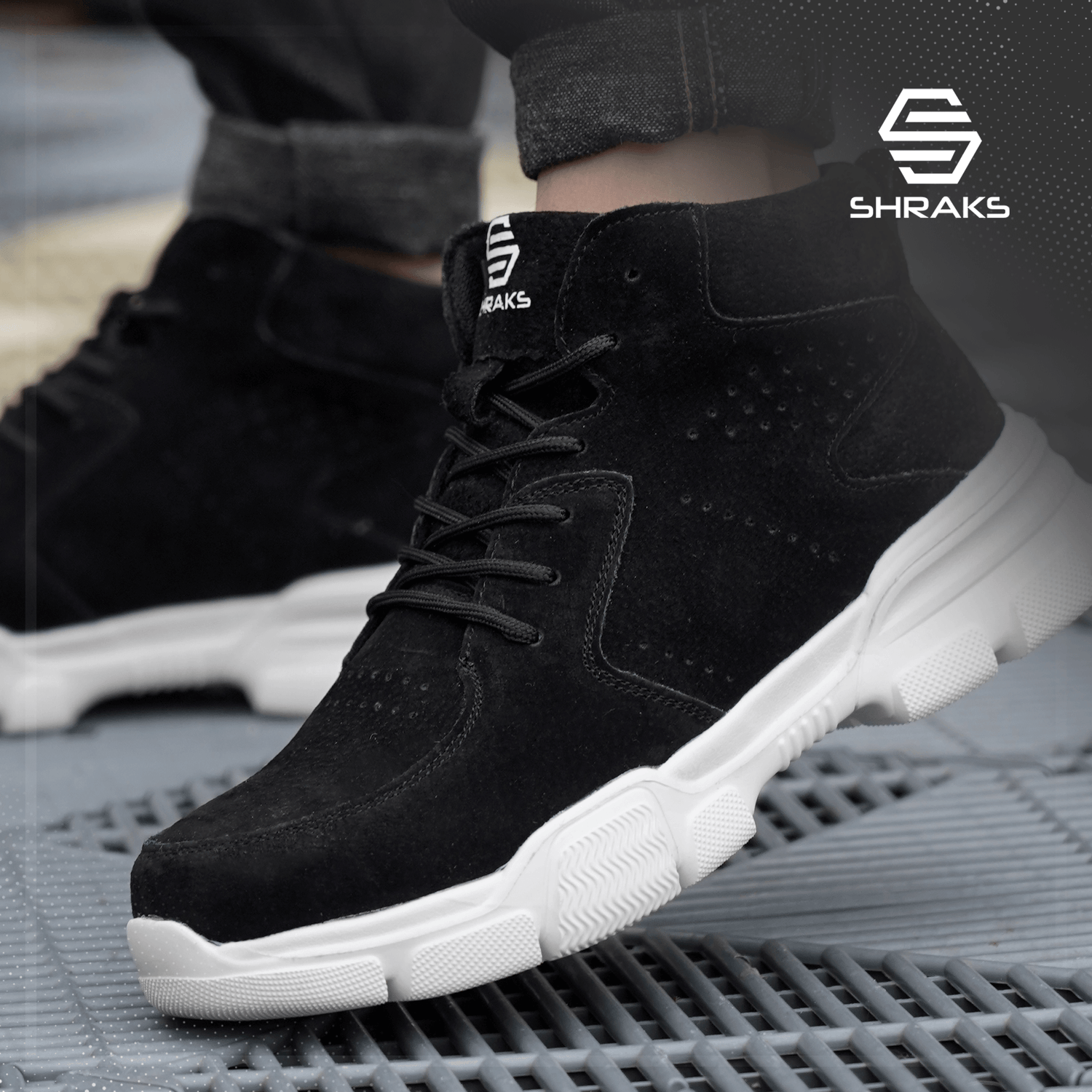
The right protection class saves you risk, money and pain at work. Instead of automatically choosing the toughest boot, decide by hazard: dry warehouse, mixed outdoor terrain, water protection, puncture resistance. This guide explains safety classes for lightweight safety shoes S1, S1P, S2 and S3 under EN ISO 20345, shows typical use cases and helps you pick the right class in a few steps. At Shraks, you’ll find sporty, lightweight models with S1P certification, and you’ll also learn when S2 or S3 makes sense. Want to know what makes a shoe “light”: What is a lightweight safety shoe?
How to read EN ISO 20345 safety classes
EN ISO 20345 defines minimum requirements for safety footwear. All classes have a toecap that withstands 200 joules. Class I covers leather or other material uppers; Class II are fully polymer or rubber (e.g., wellingtons). Key base codes: A for antistatic, E for heel energy absorption, FO for fuel oil–resistant outsole.
The most relevant classes for lightweight everyday work shoes are S1 and S1P for dry indoor use, and S2 and S3 where moisture or sharp underfoot hazards are present. The standard was updated in 2022. Many retailers still use 2011 labels, but the practical classification is comparable. New are more precise add-ons for puncture resistance and water protection, briefly explained below. For a compact overview: Safety classes S1, S1P, S2, S3 at a glance.
S1 and S1P at a glance
S1 targets dry environments without moisture exposure. Typical features are 200 J toecap, closed heel, antistatic properties, heel energy absorption and FO-resistant sole. S1 is the baseline for warehousing, logistics, assembly, workshops or production where no wet contact occurs.
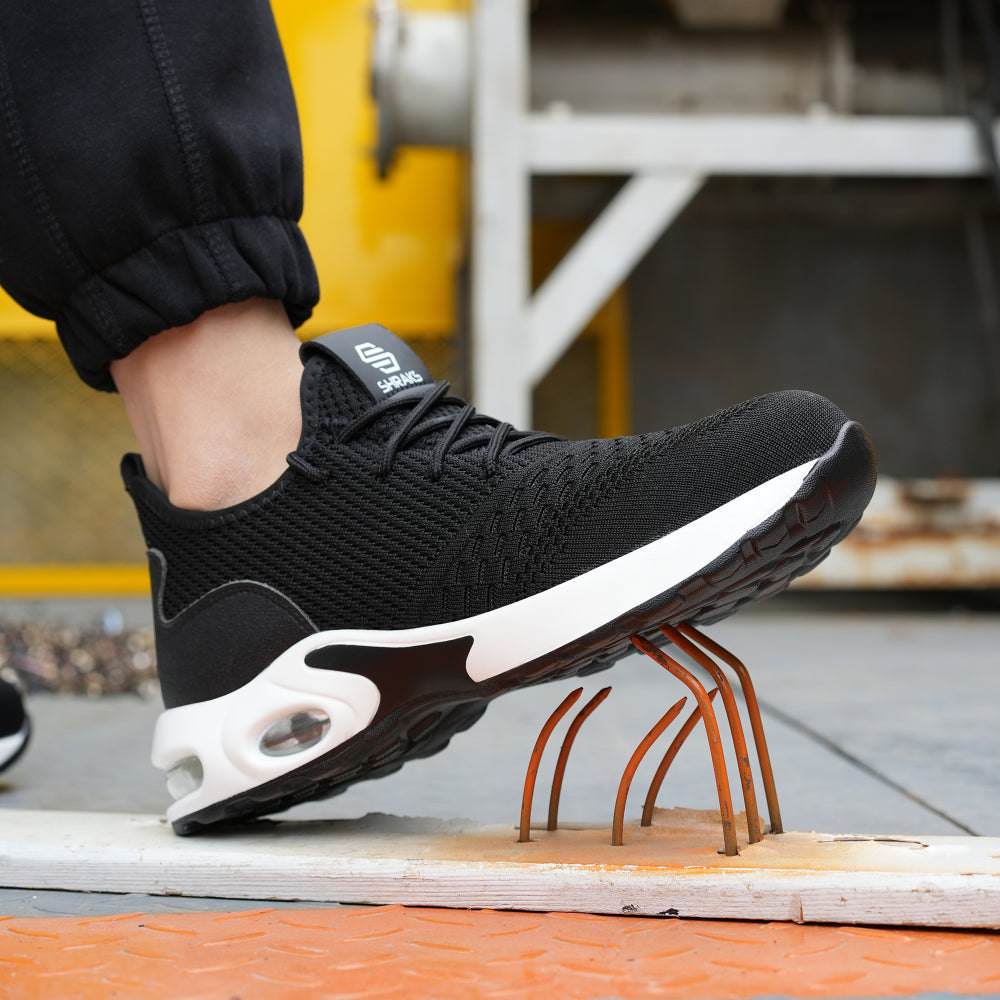
S1P is S1 plus puncture resistance in the midsole. This protects against nails, swarf, wire or splinters underfoot. The plate can be metallic or textile high-performance fibers. Textile solutions are often lighter and more flexible; metallic ones are very robust and conductive. For many who prefer lightweight, sporty safety shoes, S1P hits the sweet spot of protection and comfort. At Shraks you’ll find light S1P models with a steel toecap and a textile puncture layer such as Kevlar for high flexibility. More details: S1P Standard: Features and benefits.
When to choose: S1 if it’s dry, no sharp-object risk, comfort first. S1P if puncture hazards exist, work remains dry and you want a light, sporty feel. For comparison with the base class: SB Standard safety shoes.
S2 and S3 at a glance
S2 builds on S1 and adds a water-repellent upper. Ideal when you face moisture, splashes or routine cleaning, e.g., in food processing, facility management or outdoor tasks with occasional wetness. The shoe resists water ingress for a defined time without being a full rubber boot.
S3 combines S2’s moisture protection with puncture resistance and typically a more aggressive tread. It’s the robust choice for construction, landscaping, roadwork, shell construction or uneven, dirty and wet outdoor terrain with frequent sharp edges and nails. Choose S3 when you need both moisture and puncture protection.
S4 and S5 in brief
S4 and S5 are full polymer or rubber boots. S4 roughly equals S1 in base properties but is waterproof, easy to clean and ideal for frequent wet conditions where a fully closed boot is needed. S5 adds puncture resistance and a grippy tread, suited to sites, civil engineering or agriculture with persistently wet, muddy conditions. For many seeking truly lightweight footwear, S4/S5 matter mainly when boots are mandatory.
Quick selector: which class fits your job
- Dry, clean indoor floors, no sharp-object risk: S1
- Dry, possible nails, swarf, wire on the floor: S1P
- Intermittently wet, splashes, cleaning, but rare sharp risks: S2
- Wet, uneven, construction site, frequent sharp objects: S3
- Permanently wet, hygiene or mud, boot required: S4 or S5
More help by sector and workplace: Which safety shoes for which workplace?
2022 standard update in short: P, PL, PS, SR, WR
Puncture resistance is now coded more precisely. P denotes traditional puncture resistance, PL a textile, non-metal solution and PS a metallic one. In practice, an S1P may be labelled S1PL (textile) or S1PS (metal). Textile layers are often lighter and more flexible; metal is very robust and heat resistant. Many lightweight, sporty models favor textile.
Water protection modernized the former WRU shaft test. WR denotes comprehensive water protection, while WPA refers to water penetration performance of the upper. Slip resistance has been harmonized: instead of SRA/SRB/SRC, SR indicates additional passed slip tests beyond the base. Key tip: check actual test values in the datasheet, not just abbreviations. Deep dive on slip ratings: Slip resistance (SRC/SRA/SRB) explained.
FAQ
What do S1, S2 and S3 mean
S1 is the base class for dry areas with toecap, antistatic properties, heel energy absorption and FO-resistant sole. S2 is S1 plus a water-repellent upper for damp environments. S3 is S2 plus puncture resistance and usually a grippier tread for construction sites and rough outdoor terrain. Choose by moisture and puncture risk.
Which is better, S1P or S3
There’s no universally “better”. S1P is optimal in dry environments with puncture hazards and offers the best balance of protection, weight and comfort for light, sporty footwear. S3 makes sense when regular moisture and rough ground are added. Your on-site hazards matter more than the higher number.
What’s the difference between S1P and S1PS
Both include puncture resistance. S1P is the general label. S1PS is the more precise, updated term meaning S1 with a metallic puncture plate. S1PL denotes S1 with a textile plate. Many lightweight models opt for S1PL because it’s more flexible and often lighter.
Does S1P have a steel toecap
A toecap is mandatory, but material is not prescribed. S1P can use steel or composite toecaps, both rated to 200 J. Shraks uses a robust steel toecap paired with a textile puncture layer for low weight and high comfort, depending on the model.

Leave a comment
This site is protected by hCaptcha and the hCaptcha Privacy Policy and Terms of Service apply.